

When a pallet fails in operation, it’s not just product damage at stake. Work stops, safety incidents occur, and somebody’s purchasing decision based on price is often exposed – a decision they made years before in a different context. Choosing the right heavy-duty pallet for a demanding industrial environment is an engineering decision, and treating it as a commodity purchase is one of the more expensive mistakes a warehouse operation can make.
Understanding The Three Load Ratings – and Why They’re All Different
Most pallet suppliers issue a single quote on weight rating. It is almost always the static load capacity – the weight the pallet can hold while it’s flat on a solid surface. This number is not particularly useful on its own. Dynamic load capacity is what counts when a forklift or pallet jack is in action and moving the loaded pallet through the floor. Vibrations, accelerations, and the redistribution of the weight load during movement reduce the load that a pallet can transport safely. The dynamic capacity of a pallet at 5,000 kg static may be 1,500 kg or less.
The racking load capacity is the most strenuous specification of all. When a pallet is in an open-beam racking system with no support under its centre, the entire pallet frame carries the structural load. That same pallet at 5,000 kg static could fail catastrophically at 800 kg on the rack. Loaded pallet collapse errors are the most serious of all incidents. They not only damage products.
Before you start comparing materials or suppliers, map the load profiles across your actual operation. How much of your inventory is stored in racking versus floor-stacked? What is the heaviest load configuration that you use during a forklift cycle? Precisely answering those questions means the pallet specification is based on real operating conditions, not marketing numbers.
Deflection is a related factor that doesn’t get enough attention. Even when a pallet doesn’t fail outright, bowing under load creates problems. Unstable stacks, sensor errors in automated systems, and uneven weight distribution that stresses both the product and the racking infrastructure over time.
How Material Choice Drives Safety On The Warehouse Floor
Wooden pallets are commonly used in many operations and for low-frequency, low-intensity applications they can work. However, in heavy-duty industrial environments, they can pose a persistent risk of small but accumulating dangers. Splinters, nails sticking out, and broken deck boards pose physical risks to personnel working in the area. Shed debris makes floor cleaning more difficult and can puncture packaging on the lower levels. Wood warps and breaks down after a few cycles in wet or chemically active environments.
HDPE and composite materials largely eliminate that debris profile. There are no nails to work loose, no grain to splinter, and no organic material to absorb contamination from floor spills. In facilities where floor hygiene is a concern – be it chemical processing, food-adjacent manufacturing, or pharmaceutical warehousing – the material’s surface properties will directly impact what sanitization protocols you can even consider.
Non-porous pallet surfaces can be steam cleaned or hosed down with chemicals. Porous wood will absorb whatever it’s soaking in. Once a wooden pallet has taken on a chemical spill or moisture in a contaminated environment, the pallet is compromised in ways that are invisible to the naked eye.
Dimensional Consistency and The Cost Of Automated System Failures
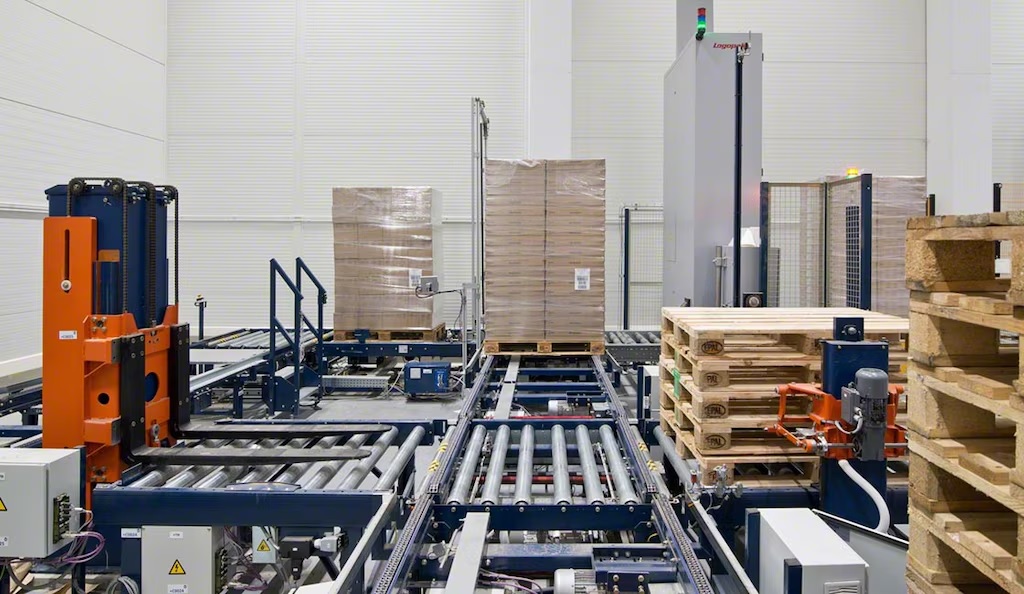
When your operation utilizes an Automated Storage and Retrieval System (ASRS), pallet choice shifts from being optional to obligatory.
ASRS machinery functions within minuscule tolerances. The sensors, the conveyors, and the robotic gripping mechanisms are all programmed to engage with pallets within a specific dimensional parameter. A pallet that’s warped, expanded, or otherwise structurally degraded after several usages will trip the sensors. At best that means a system halt and manual override. At worst, that means conveyor blockages, your product dropped in transit, or damage to the robotic arms.
Composite-engineered and injection-moulded pallets retain their dimensions over time. They won’t absorb moisture, warp with heat or cold, and they won’t chip in a manner that alters their structure. This is the principal reason why many factories with ASRS will not permit wood pallets on-site.
Total Cost Of Ownership In Closed-Loop Systems
The price comparison between a composite pallet and a standard wooden one seems easy. But the equation changes when you factor in trip count.
A standard wooden pallet will last around five to ten trips in a very tough industrial setting. A good composite pallet in the same environment can take you to 100 trips or more. The per-trip cost flips fast, and we haven’t even factored the labour of continually checking, repairing, and discarding damaged wooden pallets.
In a closed-loop supply chain, where pallets are systematically recovered, returned, and reused, high-durability pallets are almost always the better financial buy as soon as you have enough volume for the capital outlay to make sense. The recovery loop is what actually makes the economics work. A composite pallet in a one-way distribution model has a totally different cost narrative than one that’s going through a controlled manufacturing operation.
For heavy-duty situations in tight manufacturing clusters where you absolutely need that rigidity and long service life, sourcing Composite Pallets Melbourne for engineered composite material performance and a per-trip cost that beats standard hardwood over any reasonable operational horizon is the smart play.
And don’t forget to account for waste. A super-high wood turnover generates a lot of discard. Even a composite pallet that’s reached the end of its life cycle can generally be reconstituted and cycled back into the manufacturing flow.
Chemical Resistance In Processing and Industrial Environments
Warehouses aren’t the only place pallets are used. Chemical processing plants, heavy manufacturing facilities, and food-adjacent operations also store pallets in conditions that are anything but dry and ambient. Wood absorbs every chemical it comes in contact with: acids, solvents, lubricants, cleaning agents. Once that material becomes saturated or contaminated, it becomes a source of ongoing cross-contamination of your products. Mould growth in damp wood introduces biological hazard into product storage. Chemicals absorbed by your pallets can leach out and onto your packaging or product over time.
HDPE and composite pallets don’t absorb liquids. A chemical spill on the surface of your pallet is a cleaning event. The same spill on the surface of a wooden pallet may permanently compromise it. For facilities with active sanitization protocols – required wash-down cycles, chemical sterilization, or temperature-based decontamination – non-porous pallets aren’t an upgrade, they’re a requirement.
The ISPM 15 compliance angle matters here too. All wood used in export packaging used in international shipping must be heat-treated or fumigated to meet phytosanitary standards. Not only does the plastic and composite material in other pallets not serve as a repository for dangerous organisms (nor provide a nice dark, cool home for pests and vermin), bypassing the need to further treat an exported pallet can simplify your export logistics and reduce cross-border compliance overhead.
Environmental Durability For Outdoor and Extreme-Temperature Storage
Not all pallets are kept in the cozy confines of a temperature-controlled warehouse. Pallets in outdoor storage yards, on loading docks, in cold stores, or on the hot production floor are subjected to material stresses that flimsy plastics simply cannot handle.
Low temperatures cause standard injection-moulded plastic to become brittle. Impact resistance decreases dramatically, and a pallet that works fine under a forklift load at 20°C might shatter at -10°C. Heat causes low-grade plastic to creep – slowly warp and lose shape under a load. Industrial-use composites are designed to maintain their structural integrity within a broad temperature range, usually from about -20°C to +60°C.
Pallets stored in outdoor, uncovered areas are also degraded by the sun’s ultraviolet rays. The surface of the plastic oxidizes, becomes brittle, and turns white – before breaking down completely. UV-stabilized composites will resist this degradation and prolong the lifespan of the pallet.
No matter how wonderful and inexpensive a new composite material might be, the best choice for outdoor or extreme-temperature conditions is still based on which material can withstand the worst conditions the pallet will see in actual use – not just what the average condition might be in your warehouse.
Forklift Design Features That Affect Throughput
Design of forklift pockets is one of the less thought about parameters to consider while selecting pallets for high-throughput operations. Two-way entry pallets block on two sides and make it necessary for the forklift to reposition itself in cramped aisles. In contrast, four-way entry pallets come to your rescue as the forklift operators can access the pallet from any side. This becomes particularly important in setups where aisle space is restricted or pallet orientation is not regulated.
Chamfered entry edges reduce fork damage while protecting the fork tines from getting caught on the pallet face – a small thing that adds up across hundreds of movements per day. Anti-slip deck surfaces prevent your cargo from slipping off during high-speed transit and sharp cornering, helping limit product damage and the risk of load shift. Heavy-duty fork entry points help withstand the cumulative impact damage which leads to the gradual decline of the pallet structural integrity over time.
All these elements mentioned above also contribute significantly to warehouse organisation. Pallets that require manual reorienting or repositioning lead to throughput variations. This doesn’t get noticed in a single instance but multiplied across hundreds of order picks per day, this could be a big deal. Shifts delayed due to a broken pallet, a stuck fork, or a load that gave way, is all friction that’s cumulating.
Pallet Selection As A Space Utilisation Strategy
The right pallet choice determines how much vertical space a facility can safely use. When you’ve got highly rigid pallets with low deflection, you can make full use of that space by block stacking – that is, by creating floor-based stacks of loaded pallets without racking. This is the most space-efficient storage method for low-throughput SKUs in bulk storage zones, where racking either doesn’t exist or isn’t cost-effective to install.
Block stacking demands pallets with real structural integrity. A pallet that bows under load in racking will bow under the weight of stacked pallets, and eventually, that stack will come tumbling down. Rigid pallets that don’t deflect under load let you safely build three or four pallets high, substantially increasing storage density without requiring capital outlay on extra racking.
Double-stacked racking configurations also require the pallets in the lower positions to bear not just their own load but the often greater vertical pressure of everything above them. In-floor storage or picking zones where pallets are stored directly on the ground have similar requirements. In all these scenarios, the racking or floor isn’t doing all the stacking work – the pallets are.
The pallet is not a neutral surface that goods happen to sit on. It’s an active component in how a warehouse handles, stores, and moves product – and in demanding industrial environments, its specifications either match the operating conditions or they become a recurring source of failure. Getting the selection right means working backward from the actual load profiles, handling systems, and environmental conditions in your facility, not forward from the cheapest available option.

Comments are closed.